
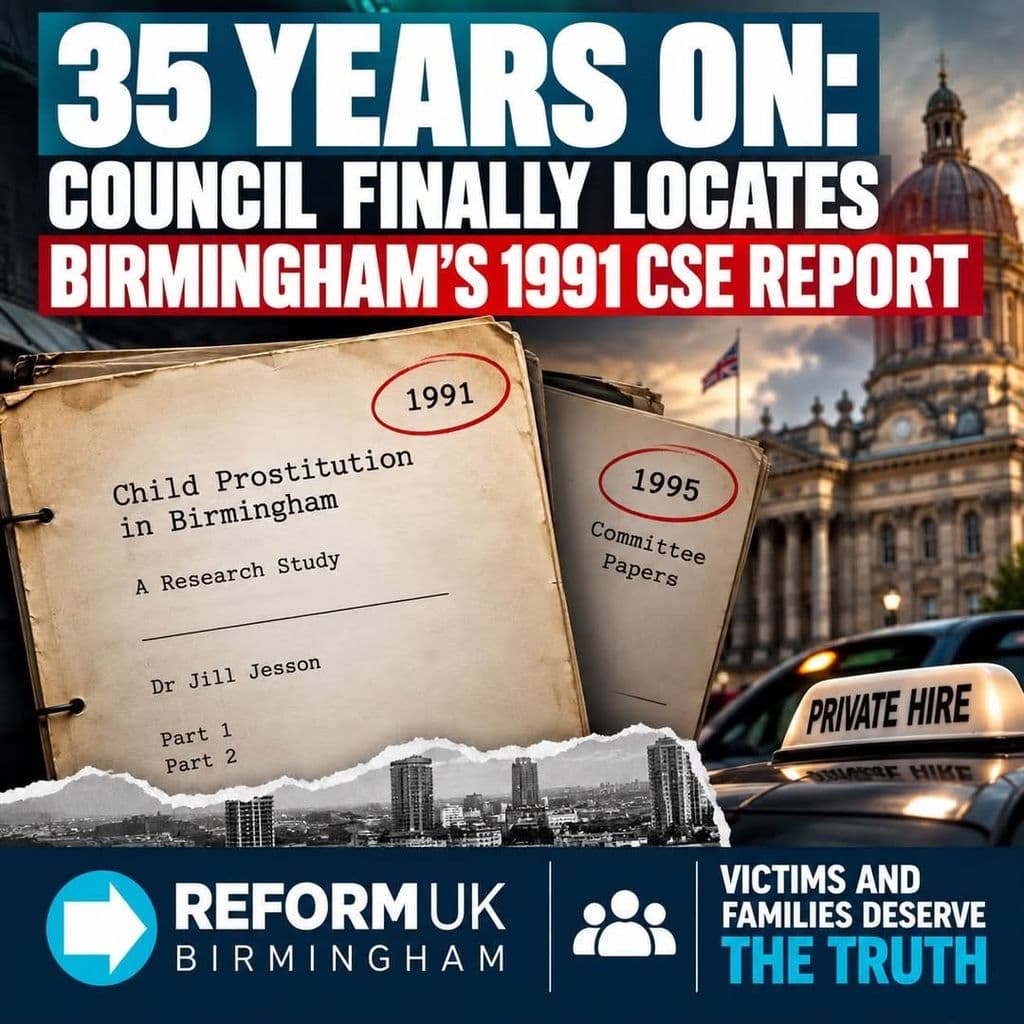
Birmingham City Council has confirmed that it has finally located the controversial 1991 Jill Jesson child sexual exploitation report, together with the relevant 1995 committee material.
The research was commissioned around 1990 to investigate what was then described as child prostitution involving girls in the Council’s care.
After six months of research, Dr Jesson produced a critical two-part report identifying serious child-protection concerns. She later said that what she had uncovered would now be recognised as grooming and sexual exploitation, and that her research identified links involving private-hire drivers. She also said she had been instructed to remove references concerning ethnicity and the private-hire trade from her draft findings. The Council subsequently disputed elements of her account.
The private-hire issue remains relevant today. Birmingham’s latest CSE report reveals that in May this year two private-hire drivers had their licences immediately revoked after West Midlands Police shared information concerning potential sexual offences against children, pending further investigation.
At yesterday’s Education Scrutiny Committee, a senior Council officer acknowledged that the 1991 report “did prove difficult for us to locate” but confirmed: “we have now found it.”
The Council says it has now located both the 1991 report and the 1995 committee papers, allowing it to better understand the sequence of events surrounding the research and its subsequent publication.
For more than three decades there have been conflicting accounts about what happened to the research.
Dr Jesson said her report had been “shelved, buried” and that she was told copies were to be destroyed. The Council subsequently maintained that the report was published in 1995, while the Birmingham Mail disputed whether the complete two-part work had been made public.
When the controversy was revisited in 2015, the Council’s then Strategic Director for People described it as a “tragedy” that many of the issues identified by Jesson had not been developed.
He concluded:
“A huge opportunity to improve the safety of children in care and to build a pioneering response to the sexual exploitation of children in care was missed.”
He added:
“The lesson is to not allow the issues to get lost, however uncomfortable the debate.”
That is why what happened to this research matters. The Council’s own subsequent assessment was that the work could have helped Birmingham improve the protection of children and develop an earlier response to CSE, but that opportunity was missed.
Had the findings been properly available, considered and acted upon at the time, Birmingham could have been better placed to recognise and respond to the exploitation of vulnerable children.
Reform UK Birmingham welcomes the fact that the material has now been located.
The question now is exactly what has been found and whether it represents the complete surviving record - including both parts of the original research, any surviving drafts or different versions, subsequent committee and scrutiny material, and records showing what decisions were taken and what action followed.
Reform UK Birmingham will now be pressing for the complete surviving record to be made public and provided in full to the statutory Grooming Gangs Inquiry.